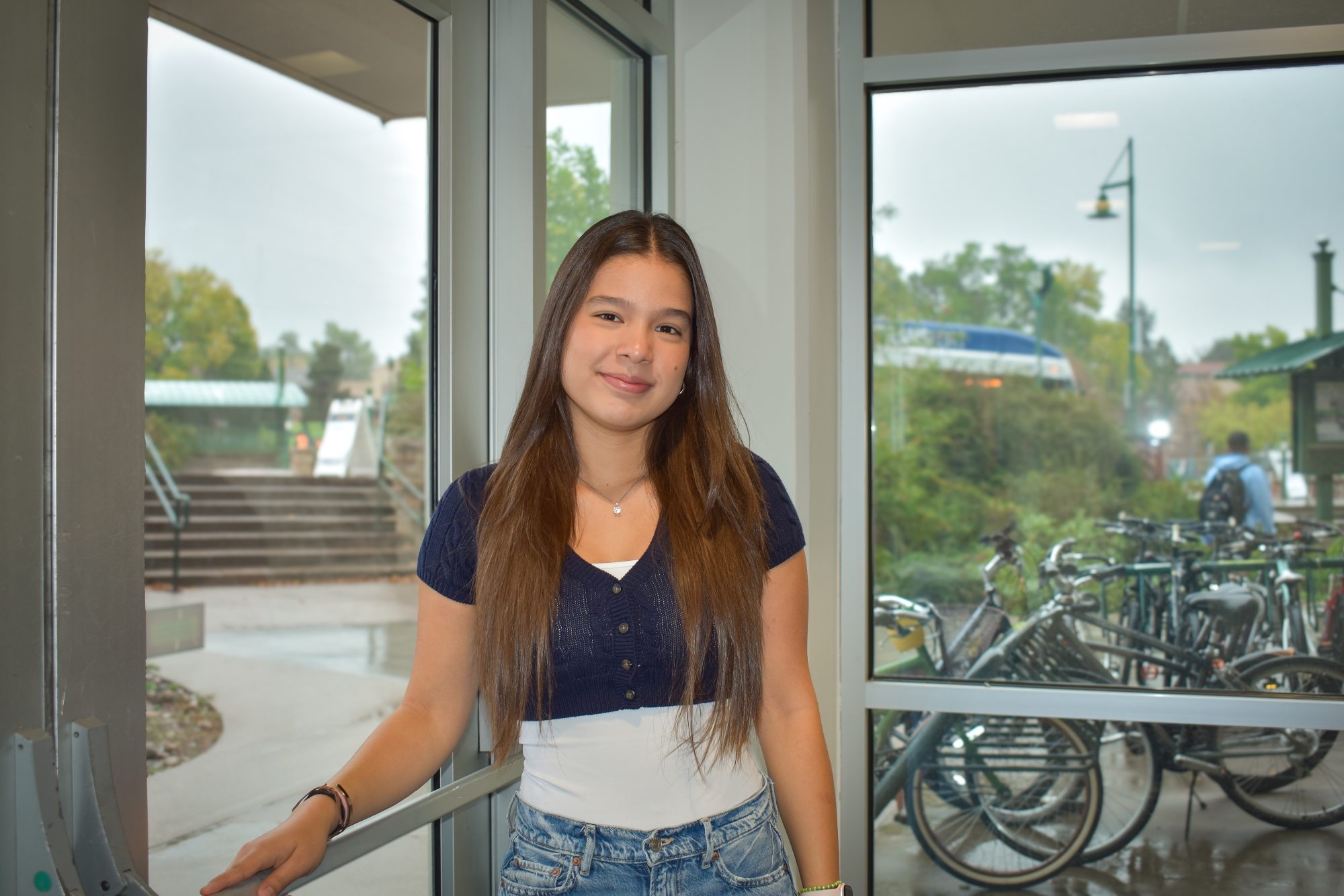
For first-year student Zoe Estevez, learning languages opens doors. An International Studies major concentrating in Global Studies, Estevez already speaks English and Spanish and is now learning French at CSU, motivated by a desire to connect with people, learn about different cultures, and expand future opportunities.
Check out the Q&A below to learn more about her experience becoming trilingual at CSU!
Q&A with Zoe Estevez
Interview and photo by Sara Penders
What inspired you to start learning French?
I always like learning about people, connecting with people, and learning more about their cultures. Aside from the requirement the major has of learning a language, I already had it in my mind because I feel like it just opens more doors. In the CSU catalog, French was a language that I really wanted to take, especially because it comes from Latin, so I thought it wouldn’t be too hard, and it is also a romance language.
What has been your favorite part about learning French?
I would say meeting new people with the same mindset as me. Learning French in my classroom, I feel like everybody goes with the mindset of wanting to learn a new language, talk to more people, and connect with them. I also have found really nice people in my class, you can find a group of people you feel really comfortable with. It’s been challenging too, like I’ll want to read in Spanish or English, but none of them work. So I have to learn a whole new way to read, so that’s been a hard part.
What is your favorite French word/phrase that you’ve learned, and what’s the hardest to pronounce?
I’ll say my favorite word is chimie, it means chemistry. I think it sounds so soft and tiny and cute. My roommate and I already talked about how her cat will be named Chimie next year when we live in an apartment.
And then the hardest one, it’s bureau, it has nothing to do with English or Spanish so it’s really hard. It means office or cabinet.
What has surprised you the most about learning multiple languages at the same time, or learning French in general?
I was surprised that it has so many similarities with both English and Spanish. I thought it was going to be more similar to Spanish, but there are so many words that are the same in English. I wasn’t expecting English to be part of French, so I think that’s what surprised me the most.
What similarities have you seen and has this process been more challenging than learning other languages?
It’s been a mix of both because of how it’s so similar. It’s good because you know what a word means and you don’t have to struggle on remembering something. But at the same time, the fact that it is the same or almost the same word, your brain wants you to pronounce it in one way when French pronounces it in a different way.
How do you hope to use French in the future?
I really want to work in something that involves international relations or communications, or even work for the FBI with an international studies major. I think I will use it in my job area, but also when I’m traveling. I would love to go to Switzerland or Canada because they speak French, and I want to be fluent so I can communicate with others.”
What advice would you give a student hoping to learn another language at CSU?
Give it a chance. It sounds like a lot when you’re learning to pronounce or read everything in another language, but it’s definitely not as hard as it looks. Yes, it’s challenging at first, but it gives you so many opportunities in the future so it brings a lot of benefits.
Interested in learning a second or third language?
In the Department of Languages & Global Studies, our programs equip you with the cultural understanding, global awareness, and real-world communication skills in ten languages: American Sign Language, Arabic, Chinese, French, German, Italian, Japanese, Korean, Russian, and Spanish.
Whether you’re interested in adding a second major, minor, or undergraduate certificate, we’re here to help you explore the languages, cultures, and perspectives that define our shared human experience.